I make "done" prove it.
Yoke
Local policy gates for Claude Code and Codex: human-approved checks, independent review and a console that shows the decision trail. A pre-release tool built around proof of completion.
$ ./list_projects.sh --sort=latest
$ ls ~/work/agentic
I made these for me / you can have a lookI have standardsMy shortcuts.
My standards.
I make "done" prove it.
Local policy gates for Claude Code and Codex: human-approved checks, independent review and a console that shows the decision trail. A pre-release tool built around proof of completion.
I gave multitasking a floor plan.
One-command setup for running Claude Code, Codex and Agy side by side in herdr. The fleet command starts workers, gives them tasks and keeps their work visible; an interactive manual lets you plan the layout first.
I gave my books a plus-one.
A private reading library with an AI tutor beside the passage: word meanings, explanations, offline natural voices, precise bookmarks and shared libraries. Readers bring their own Claude Code, Codex or API key.
I insist on a second opinion.
A Claude Code skill for supervised app-building loops. Isolated planning, generation, deterministic gates and adversarial evaluation exchange evidence through files, so the builder does not grade its own work.
I keep the whole team in view.
A coordination framework for agent teams, Kanban tasks, inter-agent messaging and multi-stage workflows, with shared memory and a signed audit trail. A dashboard keeps team activity and workflow execution in view.
I can see what ran.
A folder-scoped terminal agent where shell commands and natural-language requests share one prompt. Tool calls, file changes and approval steps stay visible, with hosted models, local Ollama or a Claude Code CLI connection.
I gave parallel work its own space.
A shell-native Git worktree manager for listing, creating and moving between workspaces by number or name. It keeps parallel agent work in separate directories without making the operator memorize paths.
I turned repetition into a skill.
A personal toolkit of reusable Claude Code skills, including article and security-research workflows. Structured instructions and supporting templates turn repeated work into a repeatable process.
$ ls ~/work/selected
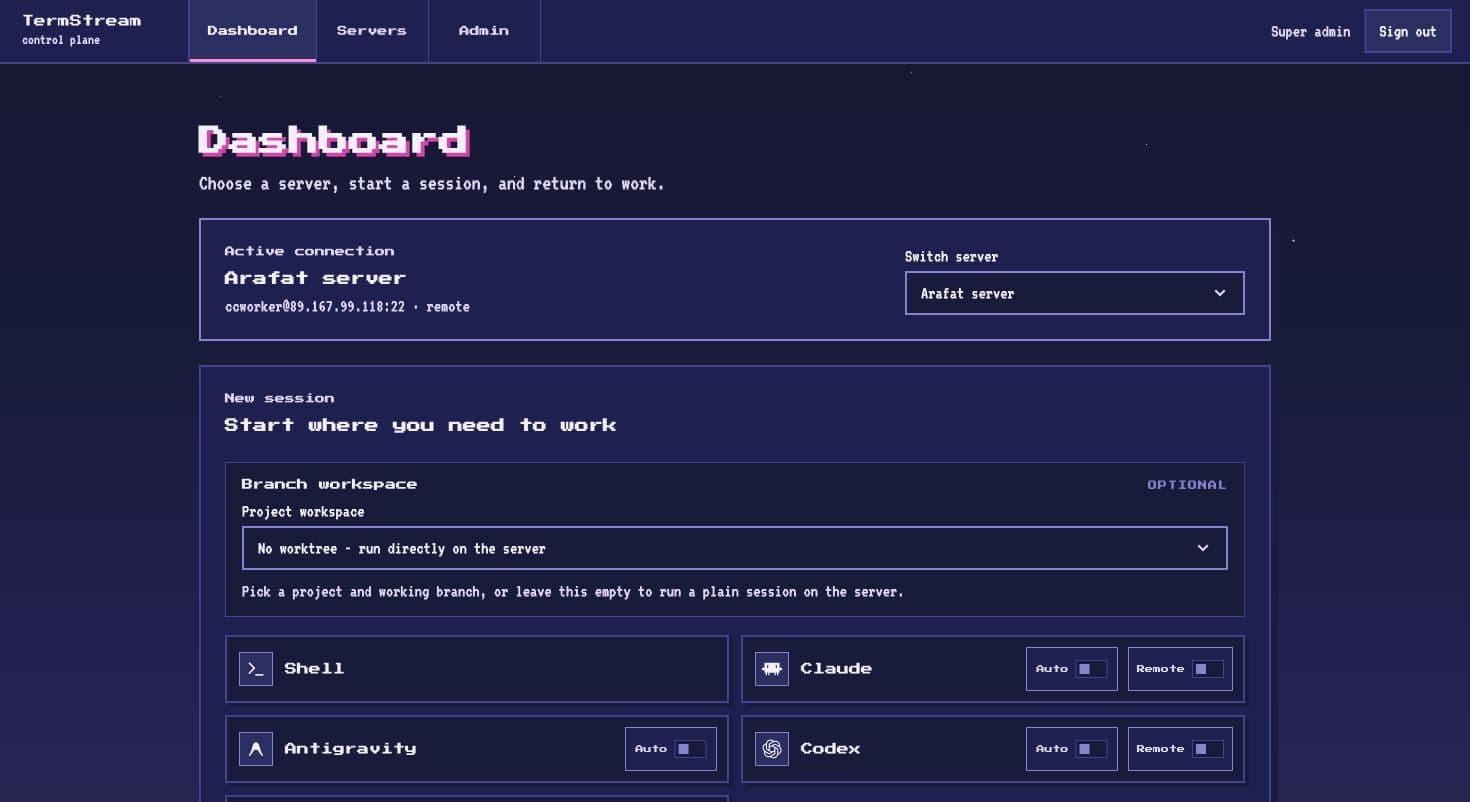
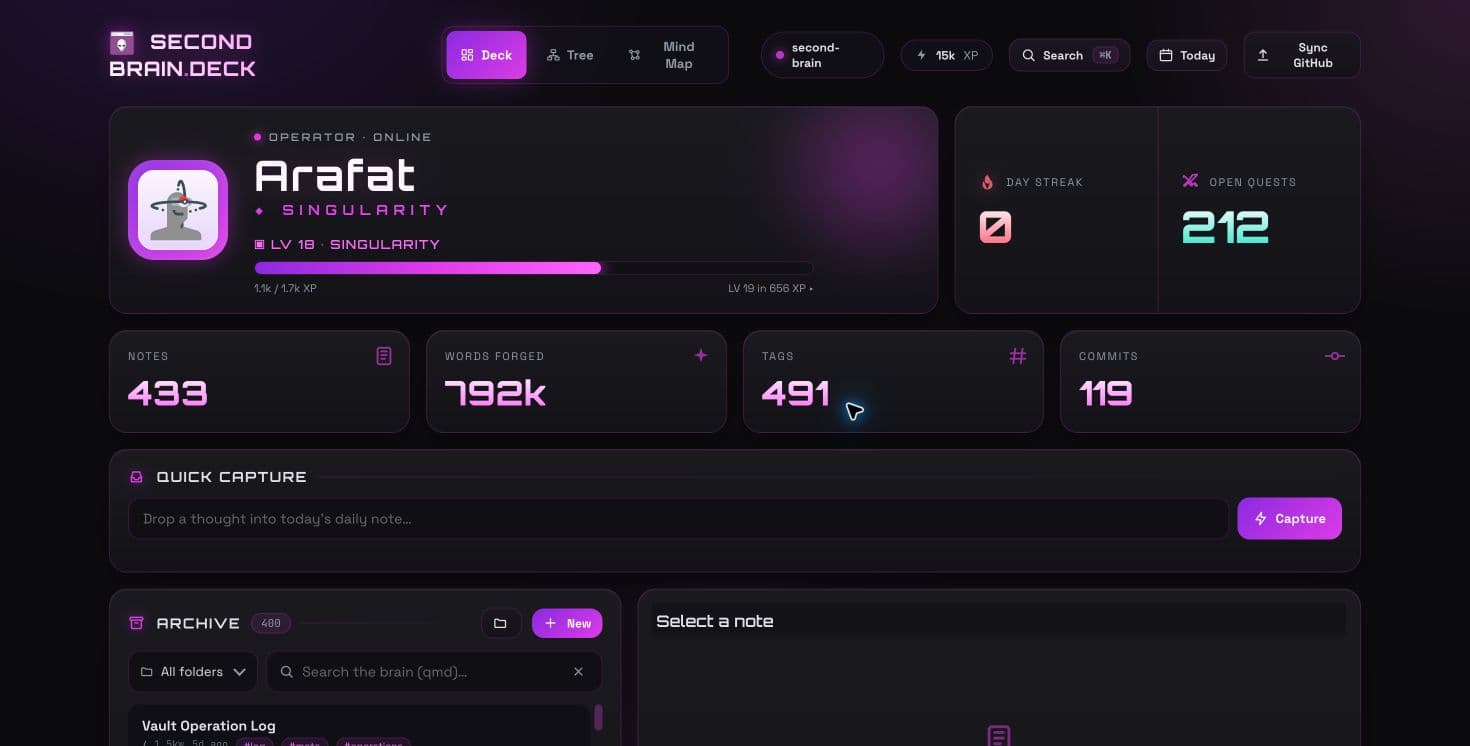
my work / actual screens includedHere are TermStream and Second Brain.Deck. I brought the actual screens. My portfolio can afford evidence.
A secure browser and mobile control plane for persistent AI coding sessions on infrastructure the user owns.
A browser control deck for an interconnected Markdown vault, built to keep useful knowledge close to the moment it matters.
$ ls ~/work/workbench
my builds / take your pickLocal policy gates for Claude Code and Codex: human-approved checks, independent review and a console that shows the decision trail. A pre-release tool built around proof of completion.
$ ls ~/work/index
40 projects / yes, I kept goingLocal policy gates for Claude Code and Codex: human-approved checks, independent review and a console that shows the decision trail. A pre-release tool built around proof of completion.
One-command setup for running Claude Code, Codex and Agy side by side in herdr. The fleet command starts workers, gives them tasks and keeps their work visible; an interactive manual lets you plan the layout first.
A private reading library with an AI tutor beside the passage: word meanings, explanations, offline natural voices, precise bookmarks and shared libraries. Readers bring their own Claude Code, Codex or API key.
A Claude Code skill for supervised app-building loops. Isolated planning, generation, deterministic gates and adversarial evaluation exchange evidence through files, so the builder does not grade its own work.
A coordination framework for agent teams, Kanban tasks, inter-agent messaging and multi-stage workflows, with shared memory and a signed audit trail. A dashboard keeps team activity and workflow execution in view.
A folder-scoped terminal agent where shell commands and natural-language requests share one prompt. Tool calls, file changes and approval steps stay visible, with hosted models, local Ollama or a Claude Code CLI connection.
A shell-native Git worktree manager for listing, creating and moving between workspaces by number or name. It keeps parallel agent work in separate directories without making the operator memorize paths.
A personal toolkit of reusable Claude Code skills, including article and security-research workflows. Structured instructions and supporting templates turn repeated work into a repeatable process.
A secure browser and mobile control plane for persistent AI coding sessions on infrastructure the user owns. It brings together owner-scoped SSH servers, repository and branch-workspace selection, and long-running Shell, Claude, Codex, Antigravity, or Python sessions so work can be resumed and operated across devices without losing control of the underlying system.
An agency delivery system for turning research, qualification, and AI-assisted production work into reviewable internal workflows. It connects evidence collection, scoring, controlled agent runs, structured outputs, and owner approval - keeping external sends manual while making the reasoning and operational trail visible.
An Obsidian-compatible knowledge system designed for high-signal capture and retrieval rather than a static notes vault. It combines queryable context, Git-backed guardrails, structured navigation, and controlled agent access so personal or team knowledge can remain useful, auditable, and easy to continue from.
A privacy-first Chrome extension that turns distraction blocking into a deliberate focus practice. Instead of silently collecting behaviour, it creates a pause before distracting sites, tracks streaks and time saved locally, and gives the user simple controls for strict sessions and blocked-site settings.
An interactive AI intelligence dashboard that translates market signals into a usable strategy view. It brings together trend coverage, investment areas, market-size and adoption indicators, methodology notes, and source-backed analysis so a visitor can explore where the opportunity is and why it matters.
Automated Wi-Fi credential extraction and Chrome password decryption using ATtiny85 microcontroller. This hardware security project demonstrates USB HID emulation for automated credential harvesting and PowerShell-based data extraction in controlled environments.
AI-powered Telegram bot for nutrition tracking. Send a meal photo and get instant calorie analysis with personalized health recommendations. Features smart food recognition and accurate nutritional insights.
Your friendly companion to mastering Linux! Learn system administration, VPS deployment, and become a Linux expert. A structured learning platform to learn Linux.
A simple and efficient domain reconnaissance tool designed for bug bounty hunters and security researchers. Automated tool for domain reconnaissance.
This Python script allows systematic browsing and extraction of links from websites up to a specified depth. It is ideal for site audit, and exploring web structures.
A comprehensive Playwright-based automation toolkit for scraping LinkedIn data including connections, search results, and posts.
Daily planner web application built with Next.js and TypeScript. Features include task management, calendar integration, and responsive design.
A robust e-commerce backend built with Node.js and TypeScript, featuring Express.js and Mongoose for database management.
A collection of Python scripts and exercises for practicing binary exploitation and buffer overflow techniques.
Python scripts for encrypting and decrypting text files using the Advanced Encryption Standard (AES) in Cipher Block Chaining (CBC) mode with a 256-bit key.
SecureShare is a revolutionary Chrome extension that solves a common problem: sharing access to online accounts without compromising security. Using military-grade encryption, it allows you to share your logged-in sessions temporarily without ever revealing your passwords.
Mission Control for your AI Agent Army. A cyberpunk-themed Kanban task management dashboard with drag-and-drop, multi-agent authentication, full CRUD persistence to Vercel Postgres (Neon), optimistic updates, and a JARVIS-inspired dark UI with scanlines and glow effects.
Transform GitHub README files into professional documentation with AI-powered formatting. Features drag-and-drop upload, GitHub repo import, auto-beautify with grammar and structure fixes, 40+ shields.io badges, real-time quality scoring, live split-view preview, and a full tools suite including table formatter, emoji picker, and license generator.
An interactive learning platform to master Git and GitHub from beginner to advanced. Features 4 structured learning paths with 26+ lessons covering basics, remote operations, collaboration, and advanced techniques like rebase and squash. Built with a terminal-inspired mint-green UI.
A full-stack book club application with React frontend and Express.js backend. Features user authentication with JWT, book management, reading progress tracking, and a polished UI built with Radix UI, Tailwind CSS, and Framer Motion. Backend powered by MongoDB with Mongoose.
A powerful web app for browsing, searching, and downloading 60,000+ WordPress plugins from the official repository. Features advanced filtering by install count, bulk CLI command generation, one-click WP-CLI install commands, personal notes system, and paginated card-based UI with plugin icons.
A cross-platform browser extension (Chrome & Firefox) that extracts titles with links from any GitHub page — PRs, Issues, Milestones, Repos, Releases, and more. Features inline hover-to-copy as rich text links and a popup for bulk extraction in Markdown, Plain, HTML, or CSV formats.
Your own personal AI assistant. Any OS. Any Platform. The lobster way. An intelligent, cross-platform AI companion that works seamlessly across different operating systems and environments.
A comprehensive tool for mapping and analyzing domain structures. Discover domain relationships, visualize domain hierarchies, and gain insights into domain configurations.
A professional-grade GPT interface built for enhanced productivity and creative tasks. Access powerful language models with a sleek, intuitive interface designed for professionals and developers.
A demonstration project showcasing Supabase's powerful features including real-time database capabilities, authentication, and edge functions. Perfect for learning modern backend development patterns.
Retrieval-Augmented Generation (RAG) system powered by Supabase. Combines vector search, semantic similarity, and generative AI for intelligent document retrieval and context-aware responses.
Proof-of-concept for CVE-2026-49975 — an HTTP/2 'bomb' combining an HPACK indexed-reference bomb with a flow-control stall to amplify resource exhaustion. Built for responsible disclosure and defensive research into HTTP/2 protocol weaknesses.
A fully containerized full-stack application wiring together React, Express, and MongoDB with Docker Compose. Demonstrates multi-service orchestration, hot-reload dev workflow, and production-ready container builds for the MERN stack.
An open dataset of Foodpanda Bangladesh restaurants — 5,316 vendors across 12 cities with reviews and menu data. Includes the Python scraping pipeline used to collect and structure the data for analytics and research.
A Chrome extension for running multiple isolated login sessions side by side in the same browser. Keep separate cookie and storage containers per profile without juggling browser windows.
A Go service that tracks the WordPress.org plugin and theme directory for updates. Efficiently polls and diffs directory metadata to surface new releases and version changes at scale.